

- Integration across sectors, because stunting cannot be solved in silos
- Community-led approaches that build ownership and sustain behaviour change
- Government extension systems as the main delivery channel
- Demand creation paired with local supply through market actors
FROM HEALTHY VILLAGE TO MALNUTRITION-FREE HEALTHY VILLAGE
Co-Creating a Model for Scale
As Ethiopia's Seqota Declaration entered its national scale-up phase, one question became urgent: What exactly should be scaled, across the country, to every district, to reach zero stunting by 2030?
The answer emerged from years of work between the Healthy Village Programme and the Seqota Declaration, returning again and again to a single test: which approaches are high-impact, low-cost, and able to survive inside the government system, without donor funding to prop them up?
The answer is the Malnutrition-Free Healthy Village model:
Ethiopia's blueprint for nutrition and WASH at scale.
The MFHV model did not arrive as a tidy plan. It was forged out of an uncomfortable realisation.
About two and a half years into implementation, the programme faced an honest reckoning. Many of its interventions were working at community level, but working is not the same as scalable. Like a lot of development programmes, the design had prioritised impact within a project setting, with NGO structures and resources behind it, and a number of those interventions simply could not be afforded or sustained inside government systems or by communities themselves once the funding stopped.
So the programme did something harder than carrying on. Together with the Seqota Declaration team, it pulled its own intervention package apart and asked of each piece: can this realistically run inside the government system, without donors? Some components were kept. Some were simplified or adapted. Some were let go, even though they worked, because they could not scale. What emerged was a "minimum viable package": integrated services that are not only effective, but affordable, replicable, and deliverable through existing government, community, and market systems, even in the absence of external funding.
That package is the Malnutrition-Free Healthy Village model. The Ministry of Health is publishing it as a national framework, merging the Healthy Village approach with the government's own Malnutrition-Free Village model into one, and naming it the unit of scale for the Seqota Declaration.
The programme's deepest contribution, then, was not a set of activities. It was the willingness to test its own work against the realities of scale, and to redesign it accordingly. The clearest way to see the result is in what was kept, what was changed, and what was reinforced as Healthy Village became MFHV.
- Simpler intervention packages, matched to government capacity
- Standardised tools and approaches for replication
- Cost built into every design decision
- Existing government structures strengthened, not duplicated
- Data systems, including digital growth monitoring
- Training pathways that cascade knowledge through government structures
- Financing pathways that keep interventions affordable within public budgets
- Governance that clarifies roles from national to community level


The result is a model judged less by perfection in a single village than by viability across a whole country.
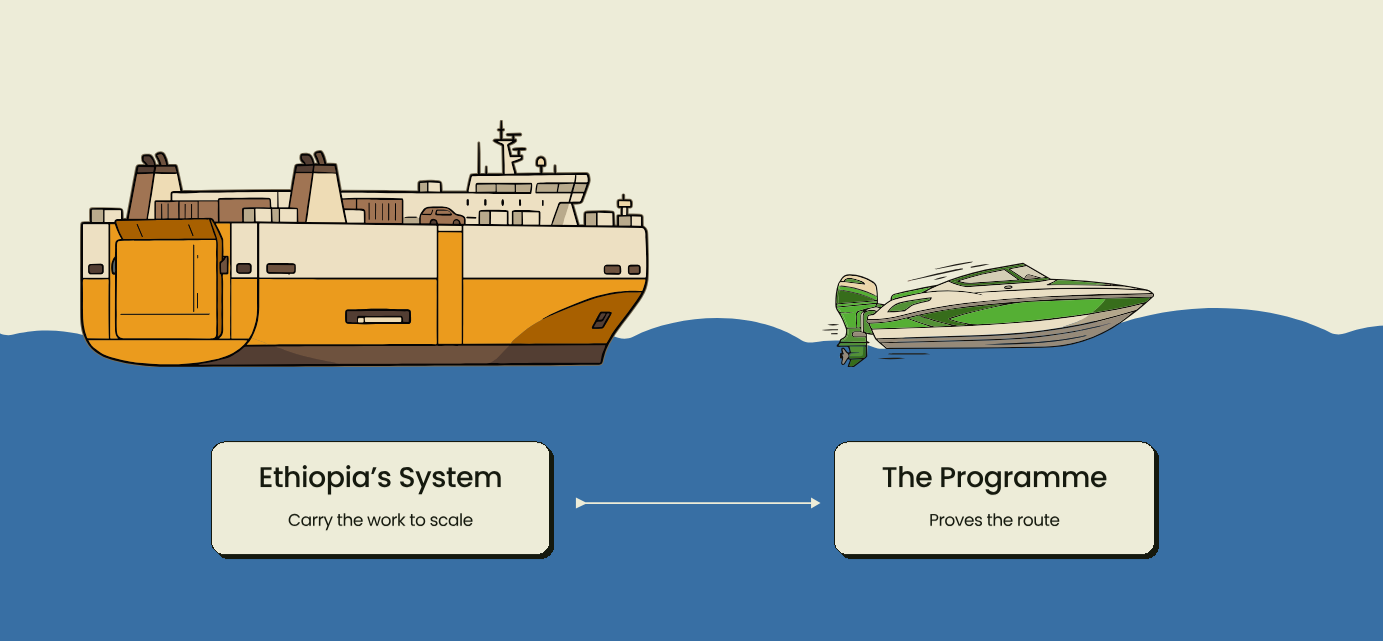
Speedboats and tankers
The journey from Healthy Village to MFHV reveals something true about development itself. Projects and systems are different kinds of vessel.
Projects are speedboats: fast, nimble, able to test ideas, take risks, and change course quickly. Systems are tankers: vast, far-reaching, built for continuity, and slow to turn. A speedboat can prove a route in a fraction of the time. But it cannot carry a nation. Only the tanker can do that.
The Healthy Village Programme was the speedboat. It moved ahead of the tanker, testing and refining what worked, then handed those proven routes over so the tanker, Ethiopia's own systems, could carry them to scale.
The scale that matters
This is what the tanker now sets out to carry. Through the Seqota Declaration's scale-up phase, the government aims to reach 125 million people across all 1,050 woredas of Ethiopia by 2030, including 31 million children under two.
No programme could reach that on its own. A government model, travelling through the country's own health posts, extension workers, and woreda plans, can.
Where this leads us to
System strengthening ends with an act of trust: letting go.
There comes a point when government is ready to lead, when communities can run their own structures, when markets can operate without support, and at that point, continued programme control becomes a constraint rather than a help. Stepping back is uncomfortable. It surrenders certainty and exposes imperfection. But it is the whole purpose.
The goal was never to perfect a model inside a programme. It was to build something a country could carry forward on its own, which is exactly the question the final chapter takes up: what does it take to make scale succeed?