
Skip to content

menu

EVIDENCE AND LEARNING

Implementing to Learn What Works

In development, activity is often mistaken for progress.

Beneath the visible activity, a harder question remains: what actually works, and what is ready to last?

Every intervention in the Healthy Village Programme became part of a larger effort to answer one national question: how do you move from successful pilots to systems strong enough to end stunting at scale?

Communities became living classrooms. Implementation became a continuous loop: test, learn, adapt, refine.

Communities became living classrooms. Implementation became a continuous loop:

Test, Learn, Adapt, Refine.

The programme's learning strategy made sure experience did not stay local or temporary. Lessons from the field were turned into evidence that government institutions could use, not just to see what works, but to understand how and why.

When evidence is built into government systems, it shapes policy, improves the quality of delivery, strengthens frontline practice, and guides decisions. Knowledge stops being documentation and becomes infrastructure for scale.

What follows are four experiments in learning by doing. Each one began as a practical problem in the field, and each one taught the programme something it carried into the next.

From Concept to practice

Four experiments in learning by doing. Each began as a practical problem in the field, and each taught the programme something it carried into the next.

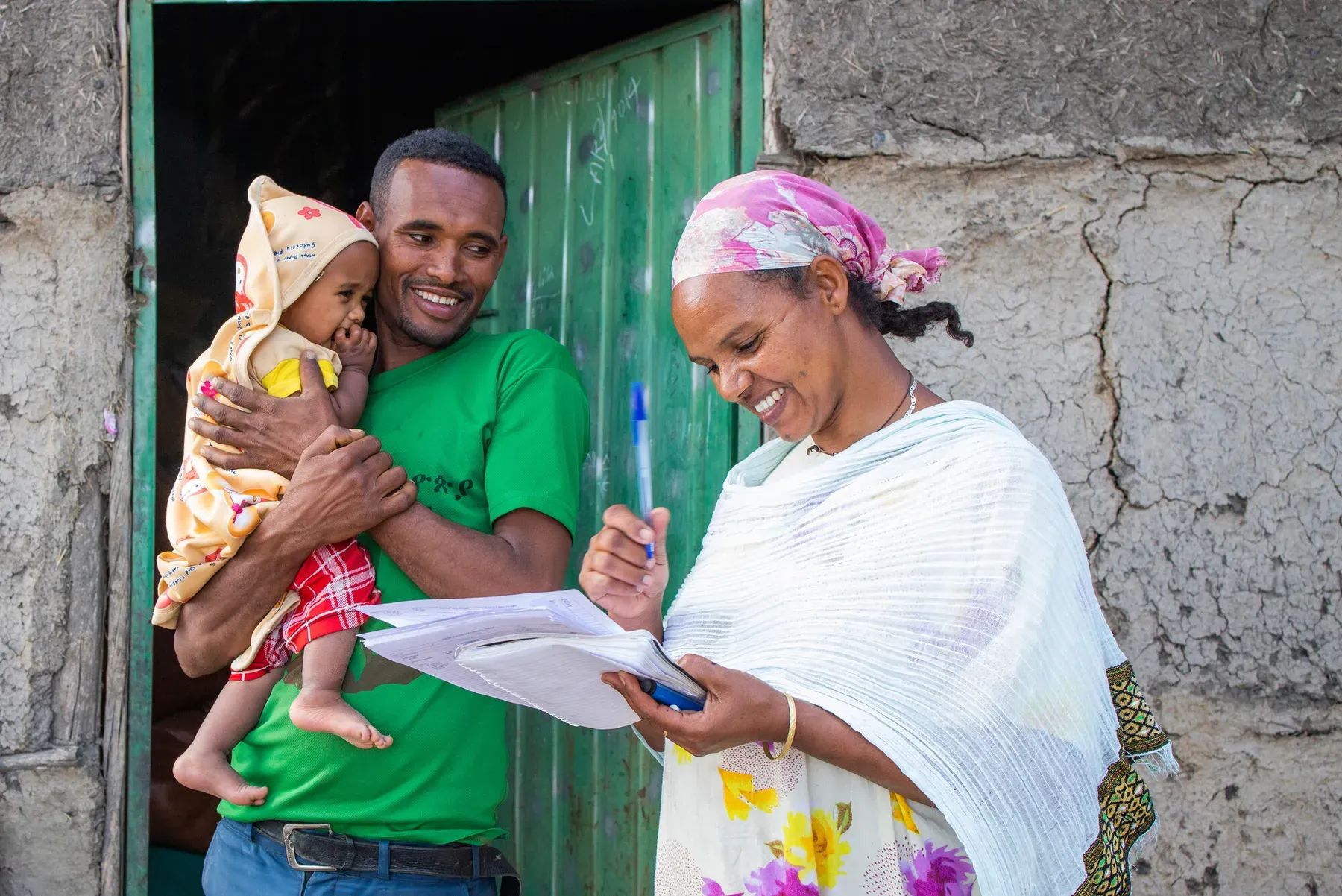
It began with a deceptively simple problem: how do you measure a child accurately? Growth monitoring had relied mainly on weight, which is useful, but not enough to catch stunting during the first 1,000 days (the window when action works best and after which the damage is hard to undo.) The answer was to add length measurement, the key sign of stunting, and to move the whole data flow off paper and into the government's own e-CHIS platform, the government's own digital health system that community health workers use to record and track care.

The shift is concrete. Where Health Extension Workers once recorded growth on paper, slow to gather and impossible to act on in real time, they now record weight and length on a tablet that generates growth charts instantly, flags children at risk, and feeds a national dashboard used for planning from district to federal level.

The pilot was not flawless: patchy connectivity, heavy workloads, and the daily realities of frontline service all shaped it. But it proved digital growth monitoring can work inside government systems, and the Ministry of Health is now extending it well beyond where the programme began.

Recognised nationally.

Out of every innovation across Ethiopia's health sector, the Ministry of Health chose just one to represent it at the country's national Digital Health Week in 2026: this digitised approach to growth monitoring.
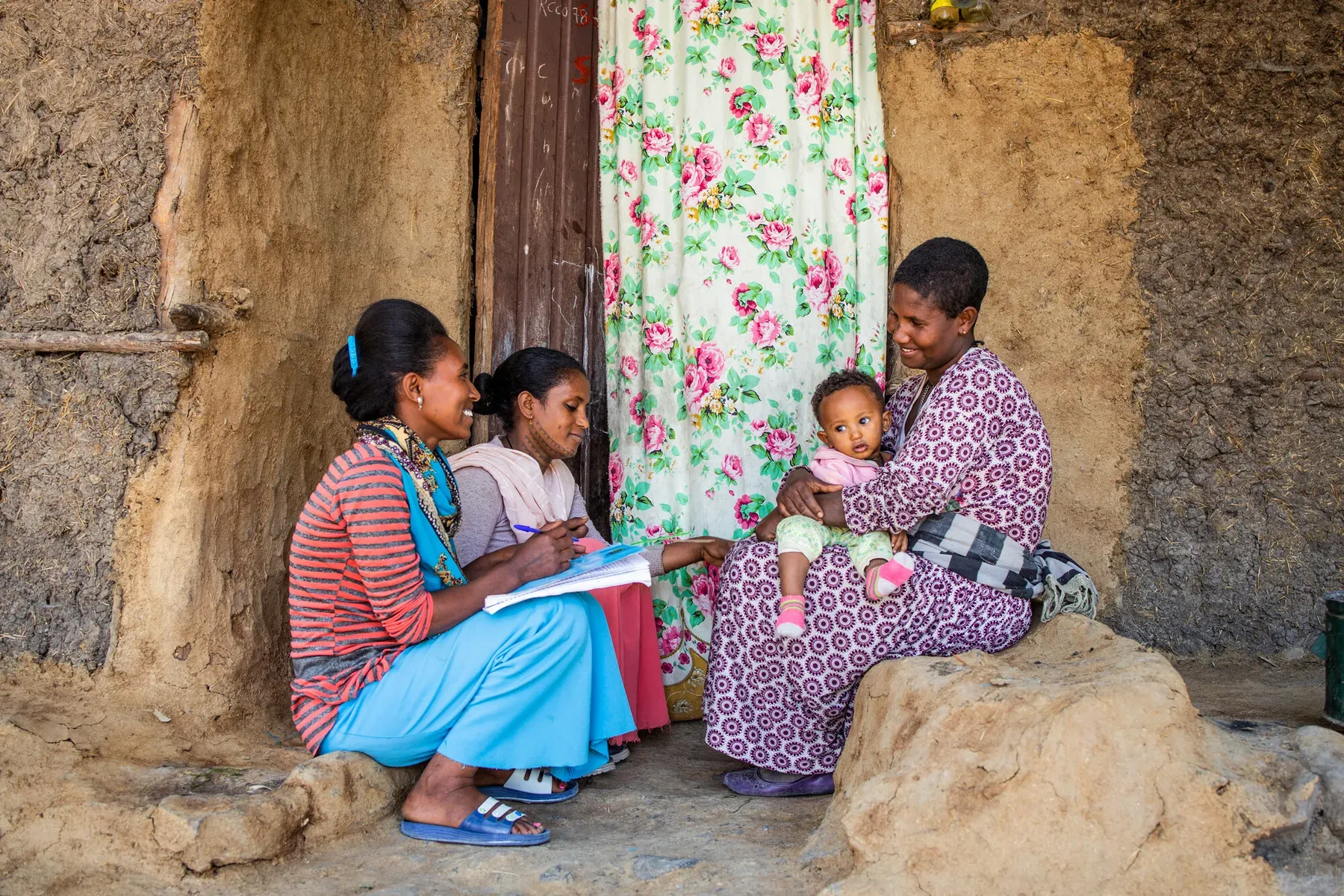
Health Extension Workers are the backbone of growth monitoring, and they are stretched thin. In one programme kebele, two workers cover more than 1,700 households between them. The question became unavoidable: when the system is this overstretched, can communities help carry the load without lowering the quality?

"We get very sad when we find malnourished children even after all the awareness we have done. Including these children in the programme cannot be the only solution. We need to work on the problems here in the kebele."

Tiruye Lakew

Health Extension Worker

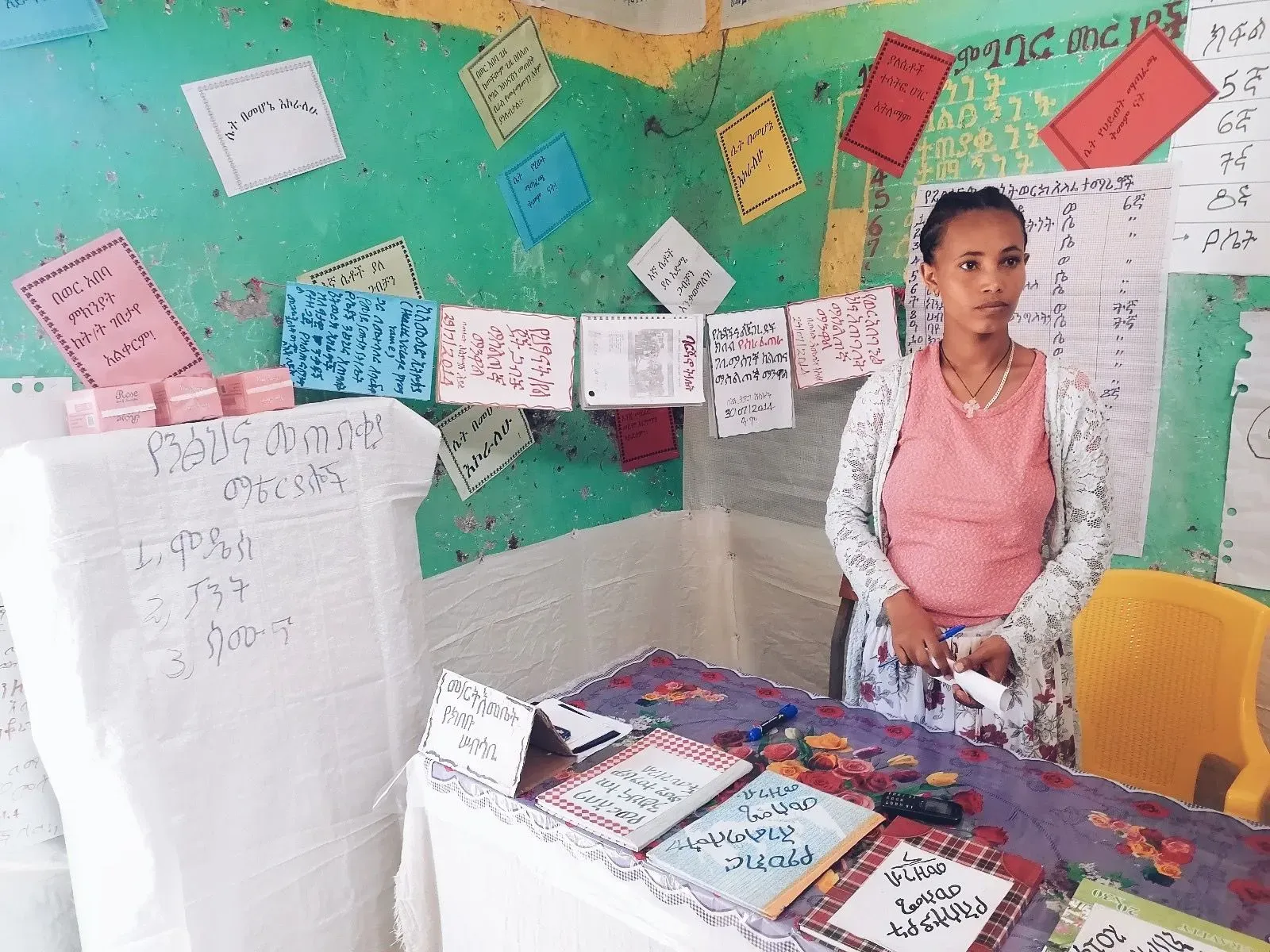
In 2025, the programme tested an answer in Emba Alaje, Tigray, through Mother-to-Mother Support Groups: trained mothers ran sessions, took growth measurements, and passed the data to Health Extension Workers for the digital system. In total, 94 groups formed across three kebeles, reaching close to 1,000 children under two.

It brought monitoring closer to home and built real community ownership, especially among women. It also surfaced the honest realities of scale, attendance dipped during harvest, some cultural hesitation lingered, the data was sometimes inconsistent, less failures than field notes, showing where supervision, incentives, and training would need to be stronger. The Ministry of Health is now watching the model closely, neighbouring woredas have asked about it, and a local experiment is becoming part of Ethiopia's national approach to community-based health promotion.

Then conflict broke out, first in Tigray, later in Amhara, and the plan met reality. Planned activities gave way to hybrid responses that paired immediate humanitarian relief with the slower work of rebuilding systems.

How hard this got is visible in the numbers. In Tigray, rural safe water coverage collapsed from 61% before the conflict to just 28% afterwards. And measuring a child's length, the very improvement the programme had introduced, became unsafe during the endline evaluation: carrying the length boards through the region would have raised the visibility of families and field teams and put them at risk, so evaluators measured weight alone. When even measuring a child safely is in question, every assumption about delivery has to be rethought.

What emerged from that rethinking was close to a blueprint for working in fragile places:

  • Build flexibility in from the start; it is survival, not a luxury.
  • Partner with community leadership to earn access and trust.
  • Trust local solutions over one-size-fits-all designs.
  • Design crisis modifiers into the programme, so it can respond fast without losing the long game.

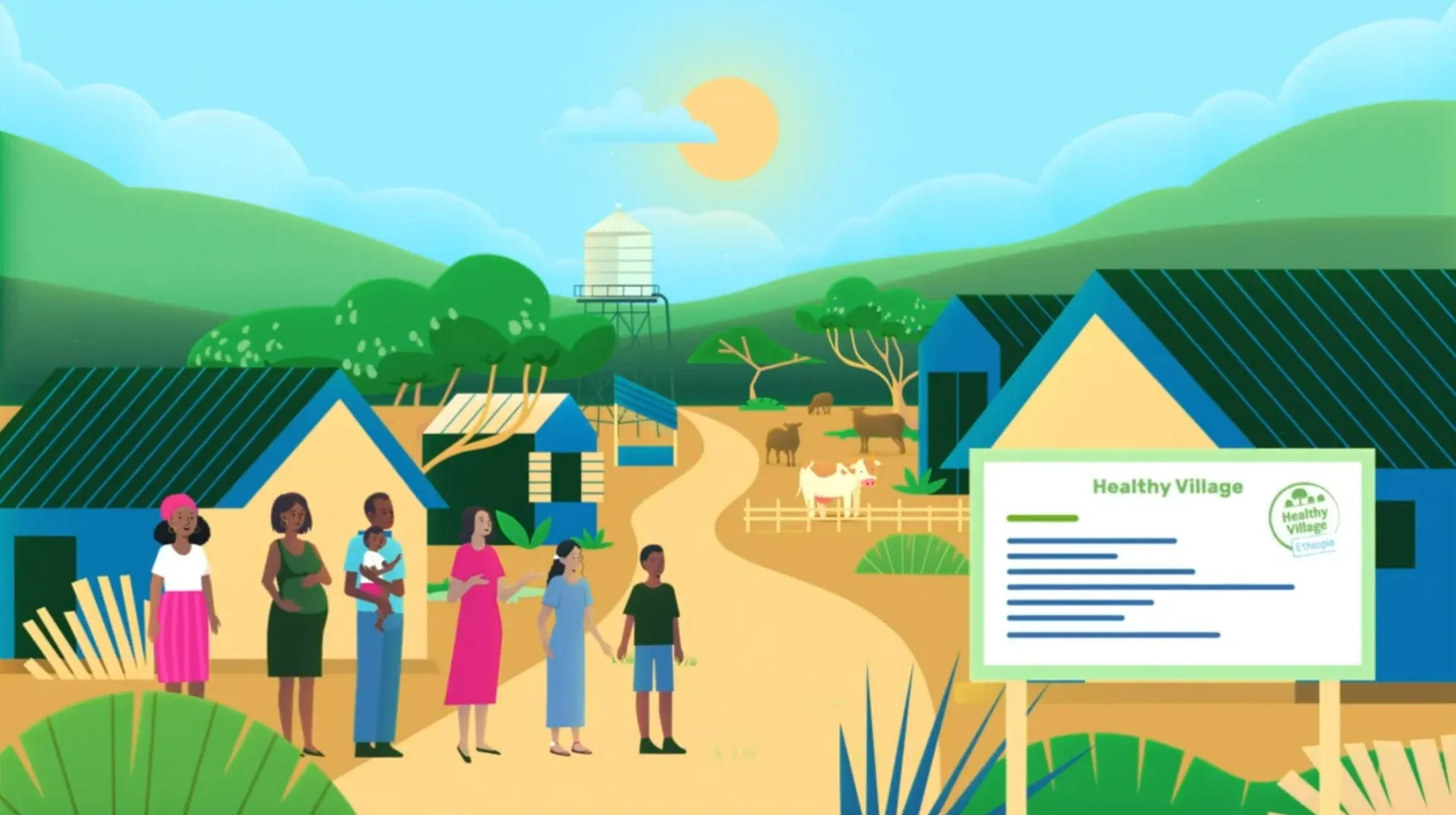
The hardest question of all: how do you know when a village is actually "healthy"? The programme needed a shared definition. The Healthy Village Tracker, built with the Seqota Declaration Delivery Unit, set out 11 indicators spanning behaviours, services, and social dynamics, from breastfeeding practice to gender-equal decision-making at home. Data is gathered household by household, verified collectively, and signed off by local graduation committees.

Each graduation was more than a milestone. It was proof that something as complex as integrated change can be defined, measured, validated, and then repeated somewhere else.

33 villages met the Healthy Village standard in 2025.

Where this leads us to

Every one of these learnings produced something more durable than a result. It produced knowledge the government could hold: a better way to measure children, a model for community-led monitoring, a way to work through crisis, a shared definition of success. But knowledge only changes a country if it travels, out of the programme and into the institutions that will outlast it. That journey, from a lesson learned in one woreda to a policy that shapes the whole nation, is what comes next.

Engagement
Previous chapter · Integrating for Child Health© 2026 Healthy Village Programme
This site is best viewed on a desktop or larger screen.