Skip to content

From Healthy Villages to a National Model

A different kind of programme.

Every year, development programmes around the world invest millions in improving child health.

And every year, many of those improvements disappear when the funding ends.

This is a different story.

The Healthy Village Ethiopia Programme was designed around one belief: lasting change does not come from delivering services — it comes from making systems better at delivering them.

Foreword

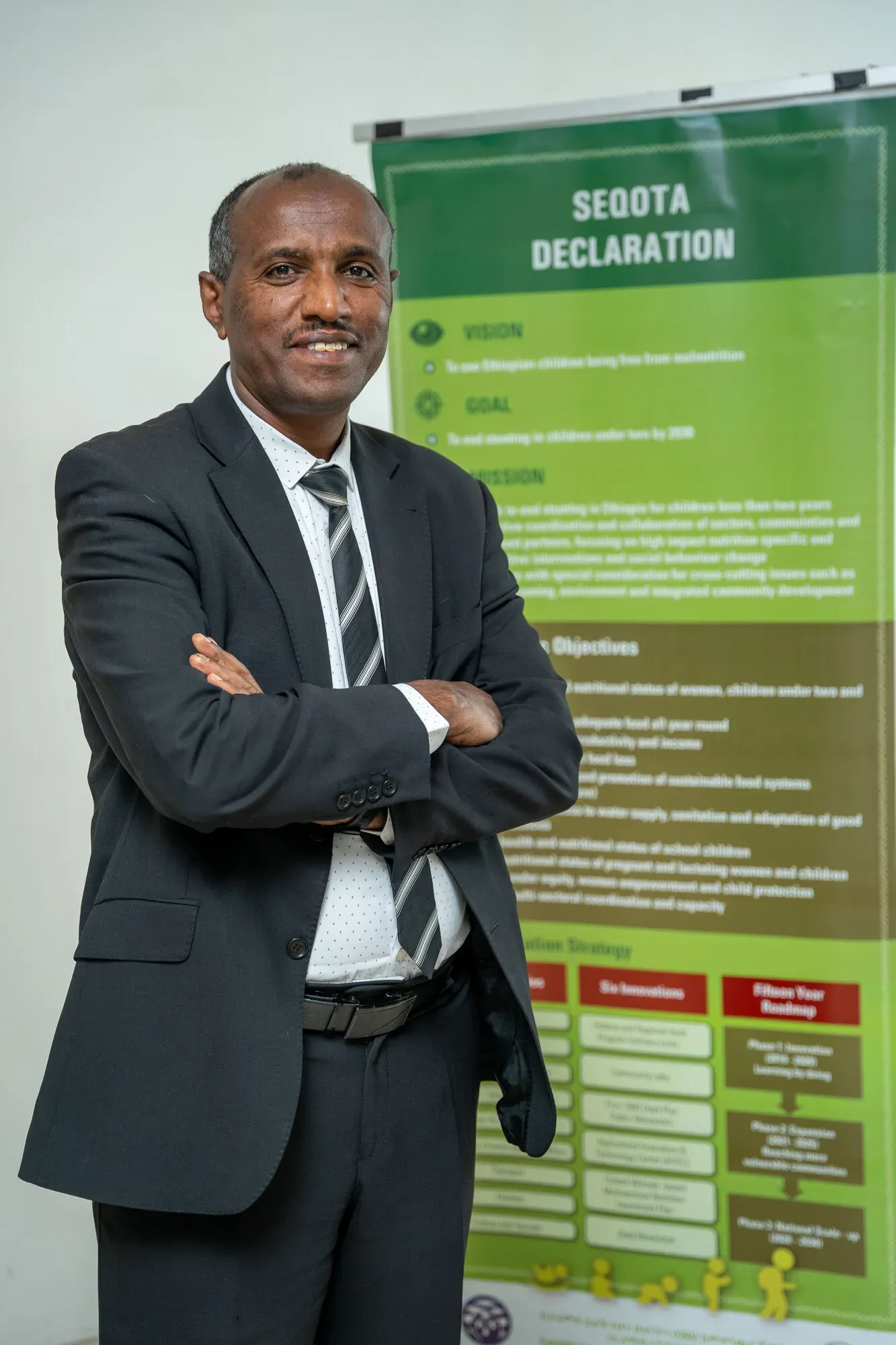
Dr. Sisay Sinamo

Ministry of Health, Ethiopia Seqota Declaration

Hiwotie Simachew

Deputy Country Director, Plan International Ethiopia

Gezahegn Kebede

Regional Director for East Africa Max Foundation

Max Foundation Plan International Government of Ethiopia The Seqota Declaration Ministry of Foreign Affairs of the Netherlands
ORDA Ethiopia iDE
The National Context

Foreword

Ethiopia's commitment to ending child stunting is an ambitious public health and development effort. Through the Seqota Declaration, launched in 2015, the Government of Ethiopia set out not only to reduce malnutrition, but to fundamentally change the systems that shape the health, nutrition, and wellbeing of children and families.

This publication reflects an important part of that journey.

Since its design, the Healthy Village Programme has been developed in close partnership with the Ministry of Health and aligned with the Seqota Declaration. What made this partnership valuable was not simply the implementation of activities, but the deliberate effort to co-create solutions that strengthen existing government systems and accelerate national goals.

The Healthy Village approach demonstrated the importance of integration. Stunting cannot be addressed through isolated interventions. By linking WASH, nutrition, agriculture, health systems, and market-based solutions, the programme showed how these sectors can work together in practical ways at community level. And the embedded technical assistance helped ensure that learning moved from the field into policy.

One of the most significant outcomes is the Malnutrition-Free Healthy Village (MFHV) model. Built from the combined learning of the Seqota Declaration and the Healthy Village Programme, it is a government-led framework for scaling integrated nutrition and WASH interventions nationally. It is rooted not in a stand-alone project, but within government systems, local ownership, and community structures. This gives us confidence that it can support Ethiopia's scale-up ambitions from 2026 to 2030.

The lessons presented here extend beyond Ethiopia. They demonstrate the value of working with and through government systems rather than around them, of learning by doing, adapting to changing realities, and building partnerships based on trust and shared priorities.

Dr. Sisay Sinamo

Ministry of Health, Ethiopia Seqota Declaration

Ending child malnutrition is not a question of knowing what to do. It is a question of building systems capable of delivering lasting change at scale.

For Plan International Ethiopia, the programme was a chance to bring decades of experience in WASH, nutrition, health, education, livelihoods, and gender equality into one coordinated approach. Rather than creating parallel structures, it empowered Health Extension Workers, Development Agents, teachers, and local leaders to drive change within their own communities.

The results showed what multisectoral investment makes possible. Gender-transformative approaches kept girls in school through better menstrual hygiene facilities, brought women into leadership and savings groups, and drew men into nutrition and caregiving. As the programme concludes, its legacy will continue through stronger institutions, empowered communities, functional local markets, and scalable national systems.

We extend our sincere appreciation to the Government of Ethiopia, to the communities who co-created these solutions, to our consortium partners, and to the Embassy of the Kingdom of the Netherlands. When systems work together, children thrive.

Hiwotie Simachew

Deputy Country Director, Plan International Ethiopia

The Healthy Village Programme was never designed as a conventional project, one that starts, delivers, and stops. From the outset it was built to trigger something larger: a shift in how child nutrition is understood and acted on at every level, from the household to the ministry.

That shift was only possible because the approach itself is integrated by design. Food security, maternal and child health, and WASH cannot move the needle on stunting in isolation. Max Foundation brought its experience in building integrated, market-based solutions that strengthen systems rather than replace them, connecting the people who deliver child nutrition from communities to the federal level, with a deliberate focus on generating evidence the government could use.

What makes us proudest is not what the programme delivered, but what it set in motion. The model now moves into a national scale-up led by the Government of Ethiopia, one that will need to scale deep, through changed mindsets; scale up, through stronger systems; and scale out, into new regions. What these five years offer is a foundation of evidence and learning to build on. Lasting change is not delivered. It is enabled.

Gezahegn Kebede

Regional Director for East Africa Max Foundation

© 2026 Healthy Village Programme
This site is best viewed on a desktop or larger screen.