
Skip to content

INTEGRATING FOR CHILD HEALTH

Where Systems Meet

A popular African proverb says that it takes a village to raise a child.

Child health, it turns out, works the same way. No single system is enough on its own.

A mother may receive nutrition advice at a health post, but if the water she uses is unsafe, the child still falls ill. A family may have clean water, but without diverse food, the child stays undernourished. A girl may learn about hygiene at school, but without facilities, that knowledge fades into frustration.

Stunting is not caused by a single failure. It is the result of systems that do not connect.

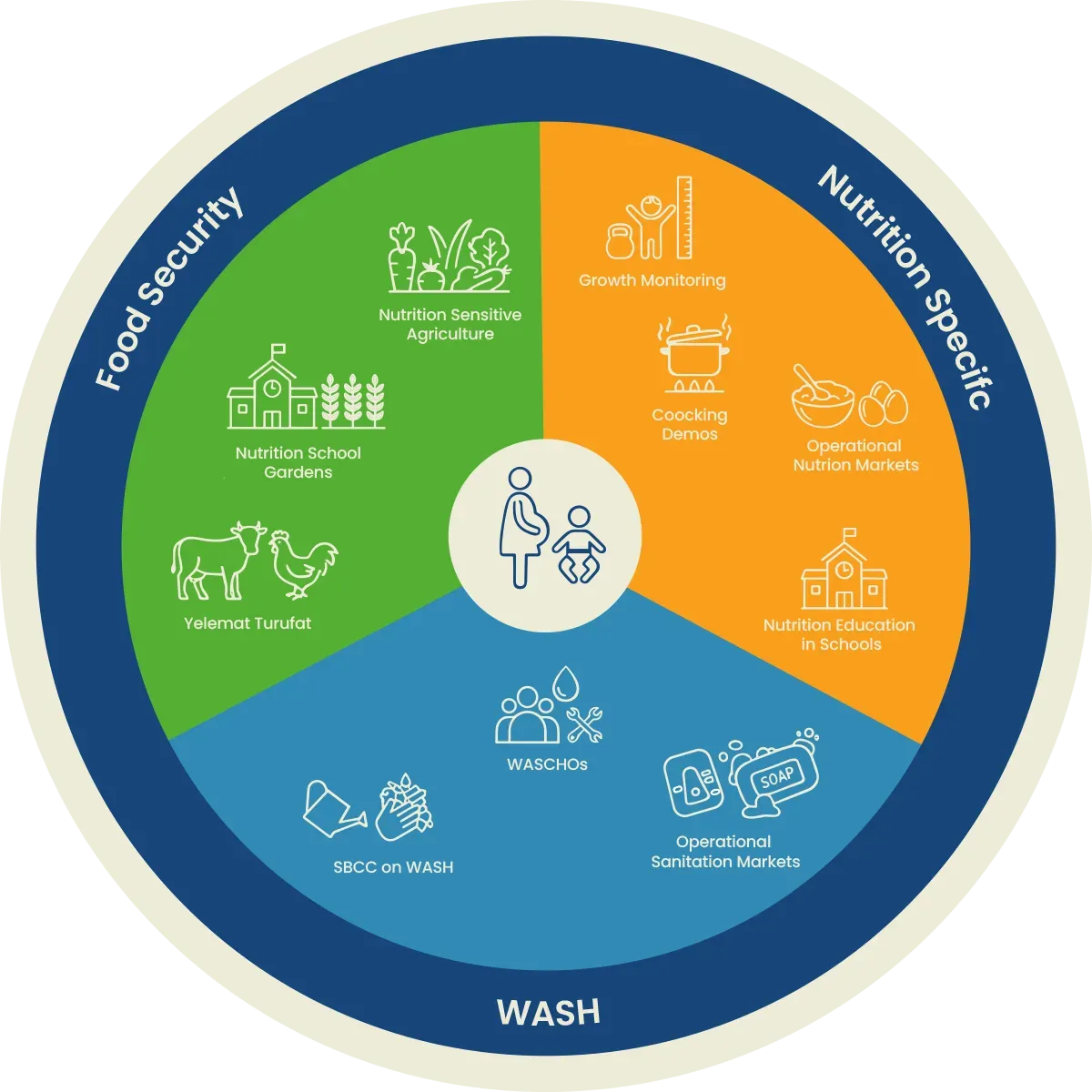
The Healthy Village Programme began with a simple premise: if the causes of stunting are connected, the response has to be too. At its core, the programme weaves together three things that are usually delivered separately: Water, Sanitation and Hygiene (WASH), Food and Nutrition Security, and Maternal and Adolescent Health.

The reasoning is straightforward once you follow the chain. Unsafe water causes disease, which stops a child absorbing nutrients. Poor nutrition weakens immunity, which makes illness more likely. Climate stress squeezes both water and food at once. Fixing any one of these alone is like repairing a single cog in a machine that is breaking down across the board.

This is what the programme means by a nexus approach: shifting attention from symptoms to root causes, so that water, food, health, and behaviour change reinforce one another.

But integration is easy to describe and hard to do. It asks sectors that rarely coordinate to plan together. It asks frontline workers to think beyond their own speciality. Left to itself, it quietly slides back into separate activities running side by side. So the real test of the programme was never the diagram. It was whether integration could be seen on the ground, village by village, household by household.

This is what that looked like.

In many communities, water used to mean long journeys and heavy loads, or a well too deep and exhausting to draw from. Through Multi-Use Water Systems, it came to mean far more. Rope pumps and solar-powered schemes brought water within easy reach, and simple filters made it safe to drink. The design went further still: the same water that fills a cup also waters a garden and sustains livestock.

The effect was layered. Families could finally collect enough water for drinking, cooking, washing, animals, and a backyard plot all at once. Gardens started to grow, adding vegetables to once-limited diets and a little produce to sell. Children stopped falling sick from the water they drank. Nutrition improved, not because of one intervention, but because water unlocked several at once. Water here is both a health intervention and an economic one.


Behaviour change without supply is just theory. A mother persuaded to feed her child better, or a family ready to build a latrine, needs somewhere to actually get the product. So the programme supported a network of local entrepreneurs to provide it: nutrition sales agents who supply fortified complementary food, and latrine business owners who manufacture and sell improved sanitation products in their own communities.

The logic is the same on the nutrition side and the sanitation side. Health Extension Workers create demand through counselling and cooking demonstrations. Local businesses meet that demand at a price the community can afford. The system keeps running because both halves of it work, and because the entrepreneur has every reason to keep going after the programme has left.

For girls, whether a school is a place of dignity or shame can come down to something as basic as a private toilet. Where schools added sex-segregated latrines and a dedicated Menstrual Hygiene Management room, paired with open education through gender clubs, the change has been profound.

Girls and boys discuss menstrual health without embarrassment, and local entrepreneurs supply reusable sanitary pads, so access does not depend on donations. In schools with the full package in place, absenteeism linked to menstruation has fallen to zero, and more than 100 neighbouring schools have taken up the model on their own initiative. The approach is spreading school by school, carried each time by teachers who decide it matters.

Often the barrier is not knowledge but money. A family may know it should build a latrine or plant nutrient-rich crops, and still lack the means to act.

Village Economic and Social Associations (VESAs) are savings groups that double as the place where conversations about hygiene, nutrition, and farming happen. A household learns about better sanitation in a session, and can take out a small loan straight afterwards to buy the materials from a local supplier. The same groups carried families through lean seasons and the disruption of conflict, letting them save, borrow, and hold on to the gains they had made. Knowledge turns into action without a wait in between, and finance is what makes the health practices possible.

Integration is not held together by systems alone. It is carried by people working across them. Health Extension Workers monitor growth, counsel families, and connect households to services. Development Agents make sure food production meets nutritional need. WASH Committees keep the water flowing. Entrepreneurs keep the products on the shelf. Each holds one piece of the puzzle, and together they make a network in which no single intervention stands alone.

Two forces quietly amplify everything above: gender and climate.

When women take part as equals in water committees and savings groups, decisions about health and nutrition begin to change, and when cooking demonstrations include men, responsibility at home starts to redistribute. Gender is not an add-on to the model. It is what makes the rest of it work harder. Climate runs through it in the same way: solar-powered schemes, drought-resistant crops, and soil-friendly fertilisers protect the gains against shocks, and where rainfall cannot be relied on, resilience is not a luxury. The clearest single expression of all this is the Participatory Integrated Plan, a farmer-led plan that pulls farming, sanitation, nutrition, and savings into one shared vision the whole household works towards.

Podcast Tip!

"Why integrating WASH and nutrition is a game-changer"

A short conversation, recorded for the course, on why you cannot end undernutrition without tackling water and sanitation at the same time, and what changes when the two finally work as one.

*This podcast episode was made available as part of our free, online course “WASH and Nutrition Nexus

Listen to the Podcast

Where this leads us

When integration is left to chance, it falls apart into parallel projects. When it is deliberately designed, facilitated, and kept up, the effects compound. Water improves hygiene and feeds agriculture. Better nutrition strengthens immunity. A little finance lets households act on what they learn. Women's leadership multiplies all of it. The pieces stop behaving like separate projects and start behaving like a system: connected, mutually dependent, and worth far more together than apart.

But making it work on the ground was only ever half the ambition. The harder question was whether any of it could last, and scale, beyond four woredas and five years. Answering that meant treating every village not just as a place to deliver, but as a place to learn.

Evidence and Learning

Field Story

Mossa had a hand-dug well in his own compound that his family barely used. Lifting water from that depth by hand was so slow and tiring that they drew as little as possible, and what they did drink kept making the children ill. "We, especially our children, were usually sick in the stomach," he says. "Health workers said it was a waterborne disease."

The programme fitted a rope-and-washer pump to the existing well, added a Tulip filter to clean the water, and supplied vegetable seeds and Mittin for his youngest child. The change cascaded. The pump made it practical to draw enough water for the household, the livestock, and a garden. The filter ended the illnesses. The family grew cabbage, chard, beetroot and carrot, bought onion seed themselves, and sold the surplus for ETB 6,000, spent on oil, salt and soap.

Even the labour shifted. Where only adults had hauled water before, older children could now manage the pump, and the programme's gender sessions reached Mossa directly.

One well, unchanged for years, became clean water, a garden, an income, healthier children, and a small renegotiation of who does what at home.

"Previously he was saying 'do it yourself', but now he has some improvements."

Mossa's wife

on his share of the household work

Field Story

Muluwork has run a small shop in Mergech kebele for four years. When Health Extension Workers and iDE staff showed her how to blend local cereals and legumes into a fortified complementary food for infants, she saw a gap worth filling: mothers were told how to make it, but most never bought all the ingredients to do so.

She started with 15 kilos and sold it within a couple of months. The profit was modest at first, awareness in the community is still growing, but she is playing a longer game.

Health Extension Workers promote the food, mothers buy it, Muluwork supplies it, and she plans to scale from 15 kilos toward 100. When the programme ends, none of that has to stop. The market itself becomes the thing that makes it last.

"I don't want to worry about the profit now, because I know I am selling something beneficial. When individuals' lives are changed, the country as a whole can change."

Muluwork Tesfaw

Mergech Kebele

Field Story

Andualem grew up in a village without clean water or toilets, went away to university, and came back to work as a supervisor at Enebre Primary School, where 407 children study. So he understands exactly what is at stake when he sets out to bring that change to his own school.

After he and a small group of colleagues took part in hygiene and sanitation training run by ORDA, one of the programme's partners, Andualem passed what he learned on to 24 students, set about reviving the school's gender club, and began preparing a dedicated room where girls can manage their periods with privacy and dignity.

His school is one of many now moving in the same direction. And that is exactly how the model has spread across the region: not by mandate, but by people like Andualem who see why it matters and start where they are.

"The training made me aware that our girl students face a lot of challenges during their menstrual cycle. I wish to see that girls stop missing class due to menstruation."

Andualem Anteneh

38, School Supervisor, Enebre Primary School

Field Story

Biyadige farms a single hectare in Tejbahir kebele and, for nearly three years, has served as its administrator without pay, mobilising his community, overseeing health and education, and working alongside Development Agents on better farming and conservation.

He is honest about where progress stalls: people do not always practise what they are taught, on latrines, on handwashing with soap, on feeding children well. His answer is to go first.

He stands for thousands of local leaders who are the real engine of this work: not the NGOs, not the donors, but the people who show up every day because they believe in something better. The programme's job was to equip them, not to replace them.

"I can't tell people to do something I don't practise myself. I do all this not because I get paid. I don't. But I want to leave my mark in my community."

Biyadige Ayalew

40, Tejbahir Kebele

Field Story

In Emba Alaje, leadership in water and savings had long been considered men's work; women who sought it were seen as stepping out of line. The programme set out to change that deliberately, reserving space for women in every committee it helped form and training them to lead. The numbers shifted: women now hold 48% of WASHCO leadership roles across the district, and all eleven committees are chaired by women.

Behafta Redai was elected to lead her village savings group despite being unable to read or write; the group appointed a vice-chair to help, and hers is now one of the strongest VESAs in the woreda. Behafta Abrha chairs her local water committee, where she rallied her community to contribute ETB 65,000 toward protecting and maintaining their water source.

"Now we have clean water, my children are healthy, and I feel proud to lead our community in taking care of it."

Behafta Abrha

37, WASHCO Chairperson

"I encourage all women not to limit themselves to household roles. Women are capable of leading and managing groups effectively."

Behafta Redai

42, VESA Leader

Previous chapter · The National Context© 2026 Healthy Village Programme
This site is best viewed on a desktop or larger screen.