

impact lasts only when local governments, communities, and private actors own the solution
ENGAGEMENT
From Programme Learning to Systems Influence
Evidence on a shelf changes nothing. Evidence inside a government plan changes how a country works.
Everything the programme learned in the field was only worth as much as its ability to travel. So the programme's third pillar had a single job: to make sure its insights were never kept internal, but actively shared, discussed, and translated into dialogue with government and other partners. Engagement was the bridge between what the programme learned and how Ethiopia's systems changed.
A programme can generate the best evidence in the world and still change nothing, if that evidence stays inside the programme. The hard part is not learning what works. It is getting a government to take that learning, believe in it, and make it its own.
That was a deliberate choice in how the programme was built. Rather than running as a parallel project beside the state, it set out to strengthen the state's own systems: working with government rather than around it, embedding expertise inside existing structures rather than creating new ones, and judging success not by what the programme delivered, but by the capacity that would remain once it was gone.
In practice, that meant four things:
- Sharing evidence and field experience beyond the programme
- Creating dialogue and alignment with government systems
- Contributing to technical processes and capacity strengthening
- Turning programme-level learning into inputs for system-level change
Sitting inside the system, not beside it
The most important of these was also the least visible. The programme placed its own technical staff inside government, with two colleagues seconded into the Ministry of Health, regional health bureaus, and the Seqota Declaration Delivery Unit.
This is what made the bridge real. Someone seconded into government is in the room when plans are written and budgets are set. They carry what worked in the field directly into the conversations where national decisions are made, and help turn it into the guidance and tools the government will actually use. It is slow and unglamorous, and it is the clearest single reason the learning outlasted the programme.
Training worked the same way, building capacity that stays. Across health, agriculture, water, and education, thousands of government workers were trained, never as one-off events, but as a deliberate cascade: programme staff train officials, who train extension workers, who train community leaders, who reach households.
When the programme ends, the trainers keep training, and those skills remain in their communities as permanent resources.
What the government took on as its own
The truest test of engagement is simple: what did the government adopt, and keep? The list is concrete.
WASH–Nutrition Integration Guideline endorsed by the Ministry of Health
Length measurement integrated into e-CHIS, the government's national digital health platform
Scaling training rolled out for the Seqota Declaration at every level
A free WASH–Nutrition Nexus online course with IRC, open to practitioners anywhere
Approaches leveraged through the national COWASH programme
And, at the centre of it all, the co-created Malnutrition-Free Healthy Village model
Each of these started as programme learning and ended as something the government owns. That is the difference between a project that delivers and a partnership that changes a system.
Bringing everyone to the table
Engagement was never only about government. Throughout the programme, the aim was to keep all the actors who shape child health, communities, donors, the private sector, and the wider development community, pulling in the same direction, because lasting change needs them aligned rather than working in parallel.
That alignment kept returning to four questions, the ones that decide whether anything actually scales:
data is not enough; scaling needs usable insight that improves decisions at every level
safe, affordable solutions that fit local systems, not complex, donor-dependent ones
diversifying beyond donor funding, valuing community contributions, drawing in the private sector
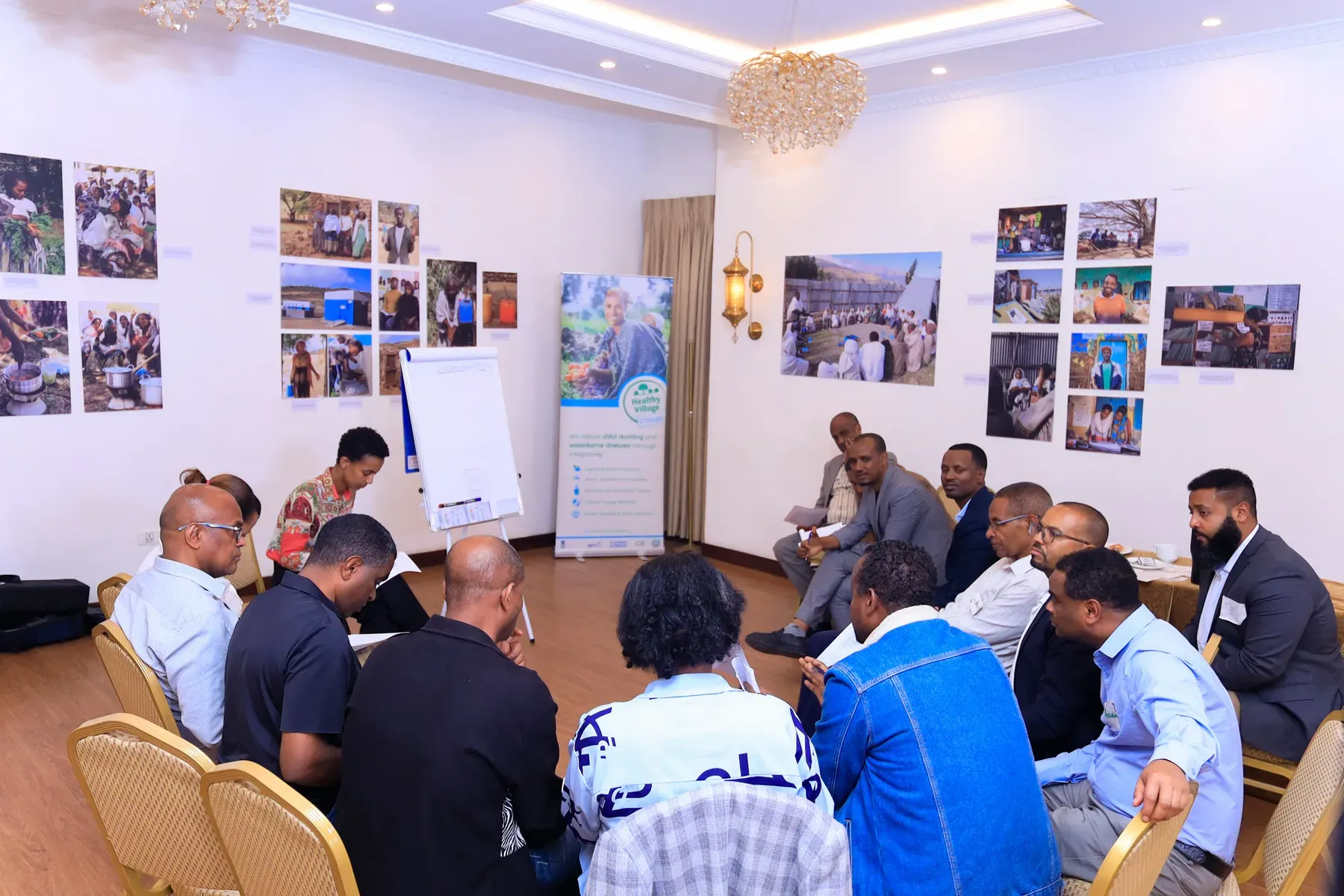
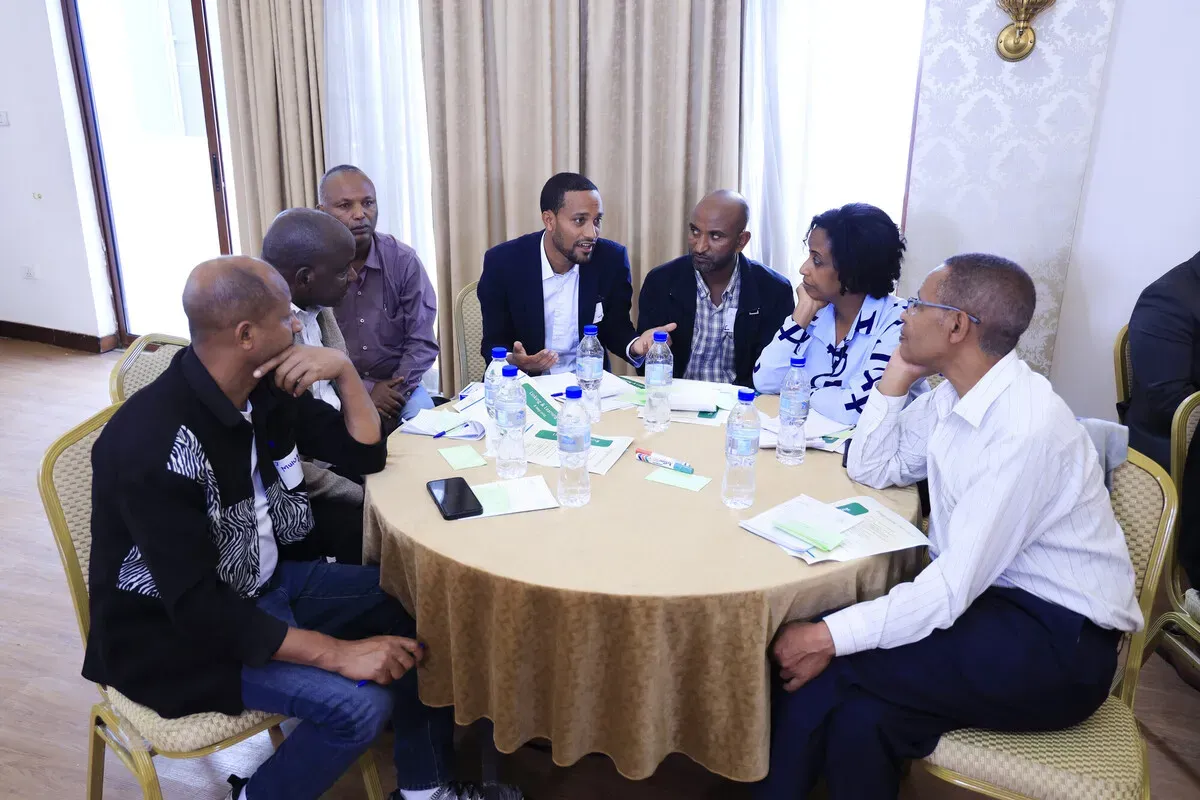
The Linking and Learning Event in Addis Ababa, in May 2025, was one clear expression of that. Co-hosted with the Embassy of the Kingdom of the Netherlands and the Ministry of Health, and bringing in voices from UNICEF, World Vision, Waterlife, the Seqota Declaration Secretariat, and several other stakeholders, it gathered the whole ecosystem around exactly these questions.
Gatherings like this were not one-off showcases. They were how the programme practised what it preached: not a single organisation delivering, but a whole ecosystem aligning behind one national goal.
The Bridge's destination: A National Model
Every part of this pillar, the seconded staff, the trainings, the guidelines, the shared evidence, was building toward one thing. At the end of 2024, the Ministry of Health published the Malnutrition-Free Healthy Village (MFHV)
Implementation Guideline: an official government framework that merges the Healthy Village approach with the government's own Malnutrition-Free Village model, and names it the vehicle for the Seqota Declaration's national scale-up across more than 1,050 woredas from 2026 to 2030.
This is the legacy that matters most. Not a programme that delivered services for five years, but an approach the Government of Ethiopia adopted as its own and wrote into national policy. What that model contains, and why it was built the way it was, is the story of the next chapter.
What this taught us
Decisions move through layers, staff turnover resets relationships, priorities shift. The work demands patience: building trust, showing evidence, returning to the same conversation until it takes root.
Embedding staff within government structures, rather than running a parallel project, was the single mechanism that did most to make the learning last.
Not what a programme delivered, but what the system can now do without it: a trained worker serving new communities, a guideline shaping practice across regions, a model written into national policy.
Without deliberate, patient engagement, even the best evidence stays trapped inside the programme that produced it.


Where this leads us to
By its final years, the programme had answered its hardest question. It was no longer whether integrated approaches work, or whether they can live inside government. It was what, exactly, the country should carry forward, and in what form. The answer had a name: the Malnutrition-Free Healthy Village. That is what comes next.
A Model for Scale